


Indonesia Introduces Administrative Framework for GMT
- May 22, 2026
- Posted by: Bella Rachmafanny
- Category: Alert
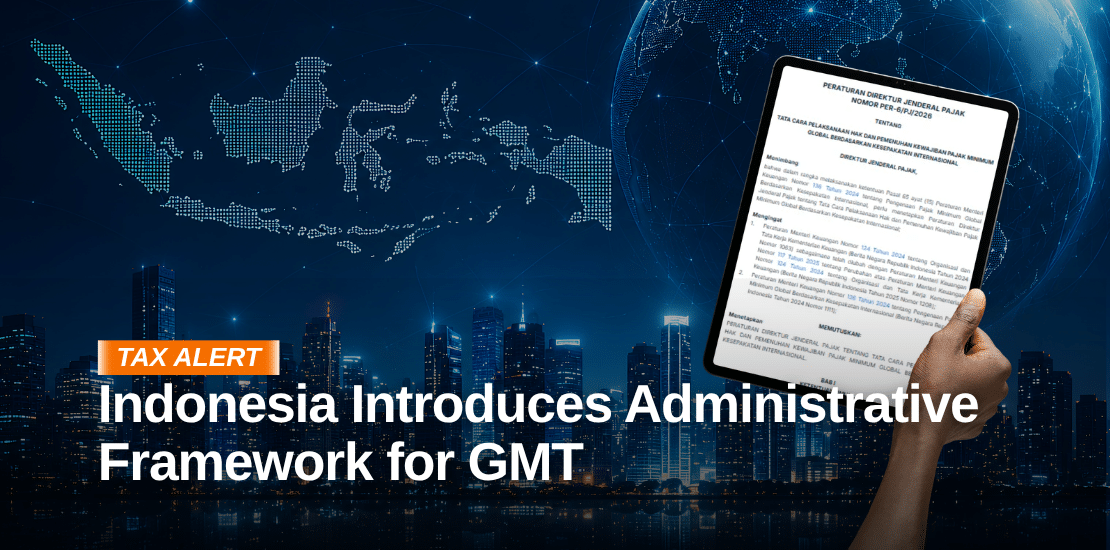
Indonesia’s Directorate General of Taxes (“DGT”) has issued PER-6/PJ/2026 dated 4 May 2026, which sets out the administrative and implementation procedures for the Global Anti-Base Erosion (“GloBE”) Rules under PMK-136/2024 concerning the Global Minimum Tax (“GMT”) regime in Indonesia.
PMK-136/2024 primarily establishes the substantive GloBE framework in Indonesia, including the scope of in-scope MNE Groups, Effective Tax Rate (“ETR”) calculations, Income Inclusion Rule (“IIR”), Undertaxed Profits Rule (“UTPR”), and Domestic Minimum Top-up Tax (“DMTT”) mechanisms. Meanwhile, PER-6/PJ/2026 serves as the implementing regulation of PMK-136/2024 and operationalizes the administrative and compliance framework for Pillar Two implementation in Indonesia. In particular, the regulation provides practical guidance on taxpayer registration, filing procedures, reporting formats, electronic submission mechanisms, notifications, tax payments, and administrative enforcement related to the implementation of GloBE in Indonesia.
The regulation consists of 24 articles and is supplemented by extensive appendices comprising 10 attachment sections (“Lampiran A–J”) covering standardized forms, filing instructions, annual GloBE tax return formats, GloBE Information Return (“GIR”), notifications, and administrative procedures.
Registration, Data Amendment, and Deregistration of GloBE Taxpayers
PER-6/PJ/2026 introduces a formal administrative mechanism requiring in-scope entities to obtain “GloBE Taxpayer Status” from the DGT. Indonesian constituent entities or joint venture group members that meet the GloBE threshold criteria must submit an application for registration electronically through the DGT Portal no later than 9 (nine) months after the end of the first GloBE fiscal year i.e., fiscal year 2025. The application must include information relating to the Indonesian taxpayer, Ultimate Parent Entity (“UPE”), MNE Group identity, first GloBE year, correspondence address, and designated administrative contact person. If the taxpayer fails to register voluntarily, the DGT may assign GloBE taxpayer status ex officio based on administrative data and information available to the tax authority.
The regulation also establishes procedures for amendment and deregistration of GloBE taxpayer status. In addition, it clarifies the treatment of post-filing adjustments to Covered Taxes, including adjustments resulting in increases or decreases to the Effective Tax Rate (“ETR”) and top-up tax computations in subsequent GloBE years. Changes to taxpayer information, including UPE identity, MNE Group information, correspondence details, or administrative contact data must be submitted electronically through the DGT Portal along with supporting documentation. In addition, GloBE taxpayer status may be revoked where the MNE Group no longer meets the in-scope entities threshold test under the “2-out-of-4 years” rule. Deregistration may be initiated either upon taxpayer application or ex officio by the DGT based on administrative verification, including cases where the taxpayer’s Indonesian tax registration (NPWP) is revoked.
Introduction of New GloBE Tax Return Forms
PER-6/PJ/2026 introduces standardized formats and filing instructions for several new GloBE-related tax returns, consisting of:
- Annual GloBE Income Tax Return (SPT Tahunan PPh GloBE),
- Annual UTPR Return (SPT Tahunan PPh UTPR), and
- Annual DMTT Return (SPT Tahunan PPh DMTT).
The regulation also provides detailed templates and instructions for the GloBE Information Return (“GIR”) and related notifications. The prescribed forms require taxpayers to disclose extensive information, including jurisdictional Effective Tax Rate (“ETR”), adjusted covered taxes, GloBE income or loss, Substance-Based Income Exclusion (“SBIE”), excess profit calculations, top-up tax computations, and allocation of IIR, UTPR, and DMTT liabilities.
The forms are designed to align Indonesia’s compliance framework with the OECD Pillar Two reporting architecture. In particular, the DMTT return includes jurisdictional ETR calculations for Indonesia, de minimis testing, SBIE computation, excess profit determination, and allocation of DMTT payable among Indonesian constituent entities with ETR below the 15% minimum tax threshold. Meanwhile, the IIR and UTPR forms require detailed reporting of top-up tax allocations across jurisdictions and constituent entities within the MNE Group.
Signing and Submission Procedures
PER-6/PJ/2026 further regulates the procedures for signing and submitting GloBE-related filings electronically through the DGT Portal. The Annual GloBE Tax Returns, GIR, notifications, and related forms must be completed accurately, signed by either the taxpayer, the taxpayer’s representative, or an authorized proxy, and submitted electronically together with the required supporting attachments. The regulation also provides standardized submission statements confirming that the information disclosed is complete, accurate, and correct, with acknowledgment of applicable sanctions under Indonesian tax law for non-compliance or incorrect reporting.
In addition, the regulation formalizes the use of electronic proof of receipt and electronic administrative correspondence generated through the Coretax Administration System. Upon successful submission, taxpayers will receive electronic acknowledgment from the DGT, while subsequent administrative actions, including registration approval, amendment notifications, and deregistration notices may also be issued automatically through the electronic system.
Notification Requirement
In addition to the submission of Annual GloBE Tax Returns and GIR, PER-6/PJ/2026 introduces a separate notification requirement (“Notifikasi”) to inform the DGT regarding the identity of the Ultimate Parent Entity (“UPE”), Indonesian constituent entities, and the entity designated to submit the GIR on behalf of the MNE Group. Unlike the submission of tax returns and GIR — which contain detailed tax calculations, GloBE computations, and top-up tax reporting — the notification functions primarily as an administrative disclosure mechanism intended to inform the DGT of the reporting structure and responsible filing entity within the MNE Group. The regulation also provides standardized notification formats and filing instructions as part of the appendices to PER-6/PJ/2026.
Subsequent Administrative Processes
Beyond registration and reporting obligations, PER-6/PJ/2026 also regulates the subsequent administrative framework for GloBE implementation in Indonesia, including payment and remittance of top-up tax, post-filing adjustments, supervision, tax audits, and dispute resolution procedures. The regulation authorizes the DGT to conduct administrative monitoring and examinations of GloBE compliance, while taxpayers remain entitled to pursue remedies available under Indonesian tax law, including amendments, objections, reductions or cancellations of tax assessments, appeals, and lawsuits. These procedures are intended to integrate the GloBE regime into Indonesia’s existing tax administration and enforcement system through the Coretax Administration System and electronic filing infrastructure.
Key Takeaways
- Indonesia has introduced detailed administrative procedures for Pillar Two compliance through PER-6/PJ/2026.
- In-scope MNE Groups are required to register as GloBE taxpayers through the DGT Portal no later than nine months after the end of the effective fiscal year.
- The regulation introduces new annual filing obligations, including GloBE, DMTT, and UTPR tax returns, as well as GIR and notification requirements.
- Electronic filing, payment, and administrative correspondence will be conducted through Indonesia’s Coretax administration system.
- The DGT may determine GloBE taxpayer status ex officio based on available administrative and exchange-of-information data.
- MNE Groups should assess the consistency between global Pillar Two reporting and Indonesian local compliance obligations, including GIR coordination and DMTT calculations.